Transforming Reefer Operations with Intelligent Trip Inspection (ITI)
Pre-Trip Inspections (PTIs) are an important but time-consuming step in preparing reefer containers for their next voyage. Shippers and operators have long faced the challenge of managing PTIs — balancing the need for thorough inspection with the pressures of turnaround time, cost, and asset utilization.
Since 2019, Star Cool’s Intelligent-Trip Inspection (ITI) is reshaping this critical part of cold chain operations with a more efficient, data-driven approach. Designed as an advanced self-diagnostics tool, ITI replaces traditional PTI procedures without compromising quality or safety — delivering savings in time, energy, and operational cost.
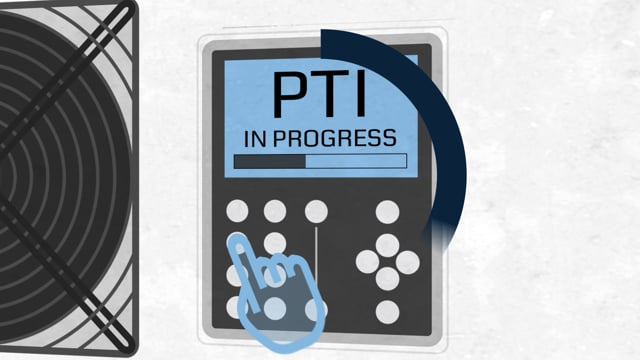
What ITI is and How it Works
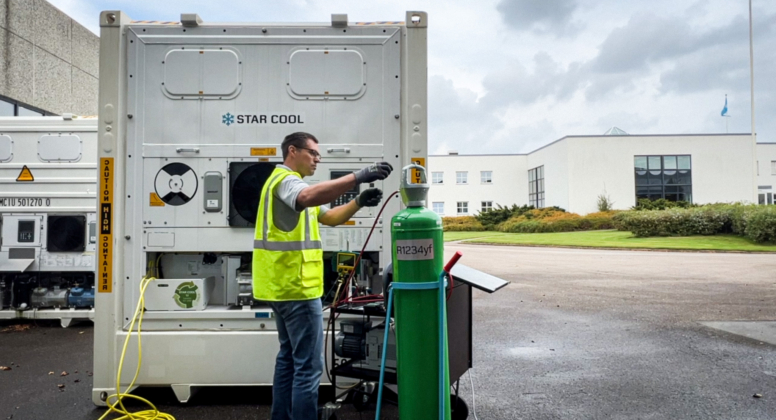
Traditional PTIs require reefers to sit idle at depots where operators conduct physical checks — often taking 2–4 hours or more depending on conditions. This involves not only testing the cooling and heating functions but also structural integrity and cleanliness before cargo loading.
Star Cool’s ITI shifts this process from depot to the journey itself:
- Continuous self-diagnostics take place while the reefer is actively carrying cargo — ensuring no additional risk or disturbance to cooling performance.
- Advanced diagnostics check all critical unit functions automatically, identifying if a unit is ready for its next reload without the need for a full physical inspection.
- Sekstant connectivity allows operators to access ITI status and historical data online — enabling advanced planning for inspections and proactive service decisions.
Once a container receives a positive ITI checkmark on its Star Cool display, only a brief visual inspection and routine wash are typically required before the next loading.
Real-World Results
Operators are already experiencing significant benefits from this innovation. At Eimskip’s terminal in Aarhus, Denmark, reefers arriving with the ITI checkmark are inspected and washed in about one hour — cutting PTI time by more than 50% and improving terminal flow.
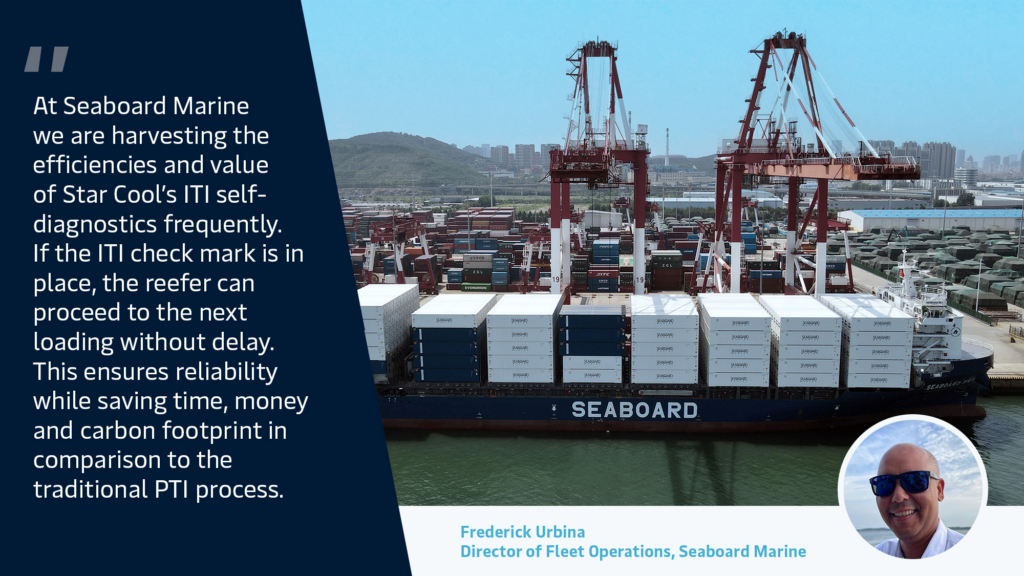
The benefits extend across the industry. As Frederick Urbina, Director of Fleet Operations at Seaboard Marine explains:
“At Seaboard Marine we are harvesting the efficiencies and value of Star Cool’s ITI self-diagnostics frequently. If the ITI check mark is in place, the reefer can proceed to the next loading without delay. This ensures reliability while saving time, money and carbon footprint in comparison to the traditional PTI process.”
Why ITI Matters for the Cold Chain
The adoption of ITI delivers benefits across multiple dimensions:
Operational Confidence:
Real-time diagnostics and remote visibility strengthen reliability across the cold chain.
Faster Turnarounds:
More reefers processed each day with fewer delays.
Lower Costs:
Reduced manual inspections, handling, and equipment wear.
Enhanced Sustainability:
Lower energy use and carbon emissions through fewer idle units and smarter maintenance.
A Step Toward Smarter Reefer Operations
ITI is more than just an efficiency tool — it’s a shift toward smarter, data-driven reefer management. By empowering reefers to assess themselves in real time and reducing reliance on manual inspections, ITI supports faster, safer, and more cost-effective cold chain logistics.
With customers such as Eimskip and Seaboard Marine already realizing measurable value, and with digital connectivity continuing to evolve through solutions like Sekstant, ITI is helping move the industry beyond traditional PTIs toward faster, more efficient, and more sustainable cold chain operations.